MKSAP Quiz: Emergency department evaluation for headache
A 45-year-old woman is evaluated in the emergency department for headache and impaired consciousness 60 minutes after onset of symptoms. She has a history of hypertension treated with lifestyle modification. The patient has a 20-pack-year smoking history.
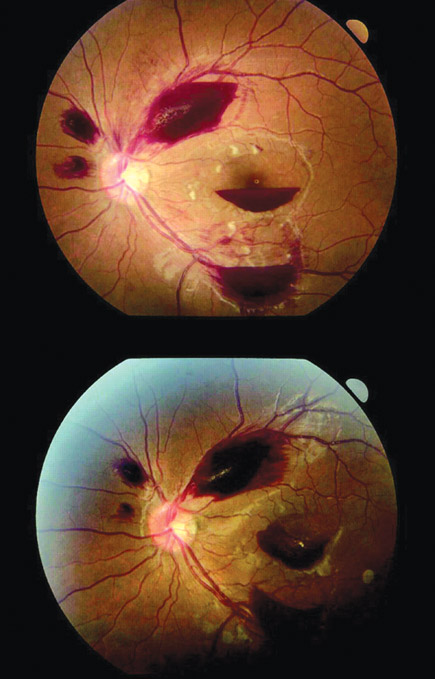
On physical examination, blood pressure is 158/68 mm Hg, pulse rate is 68/min and regular, and respiration rate is 16/min. Nuchal rigidity is noted. The pupils are reactive and symmetric in size and shape. On neurologic examination, the patient requires constant painful stimuli to follow commands and answer questions and moves the left side of the body less than the right. Results of funduscopic examination are shown.
Results of laboratory studies show a platelet count of 320,000/µL (320 × 109/L), an INR of 1.1, and a serum creatinine level of 1.1 mg/dL (97.2 µmol/L).
Which of the following is the most appropriate diagnostic test?
A. Cerebral angiography
B. CT of the head without contrast
C. Lumbar puncture
D. MRI of the brain without contrast
Answer and critique
The correct answer is B: CT of the head without contrast. This question can be found in MKSAP 16 in the Neurology section, item 7.
This patient should undergo CT of the head without contrast. At presentation, she has headache, impaired consciousness and focal neurologic symptoms, all of which suggest a cerebral mass lesion with
elevated intracranial pressure. The presence of subhyaloid hemorrhages on funduscopic examination suggests an aneurysmal subarachnoid hemorrhage. Because the examination findings are neither sensitive nor specific enough for this diagnosis to be made, prompt neuroimaging is required. CT is readily available, can be quickly performed, and is the test of choice to rule out intracerebral hemorrhage, subarachnoid bleeding, and hydrocephalus, which may require rapid neurosurgical intervention.
Cerebral angiography is inappropriate because the immediate source of impaired consciousness should be evaluated with parenchymal imaging. Angiography may ultimately be required to identify the cause of the hemorrhage, such as cerebral aneurysm or vascular malformations, but CT is first necessary to confirm bleeding and to detect possible hydrocephalus or a mass effect that may require immediate surgical intervention.
Lumbar puncture should not be performed as the initial diagnostic test in the setting of headache, impaired consciousness and focal neurologic symptoms until a mass lesion has been ruled out because of the risk of precipitating cerebral herniation.
Besides being more time consuming, not readily available, and less cost-effective, MRI of the brain leaves the patient in a less-monitored setting during the scanning than does CT. In the acute setting, mass effect and herniation should be diagnosed as quickly as possible to enable rapid neurosurgical intervention.
Key Point
- CT of the head without contrast is the test of choice to rule out intracerebral hemorrhage, subarachnoid bleeding and hydrocephalus.