MKSAP Quiz: Oral mucosal lesion
A 24-year-old male truck driver comes for a routine examination in order to renew his commercial driver's license. The patient is asymptomatic. Medical history is unremarkable. He does not engage in risky sexual behavior or take any medications. A recent HIV test was negative. He has used smokeless tobacco for 14 years.
On physical examination, vital signs are normal. Dentition is poor. An oral mucosal lesion is shown. There are no oral masses or ulcers and no cervical lymphadenopathy. The remainder of the examination is normal.
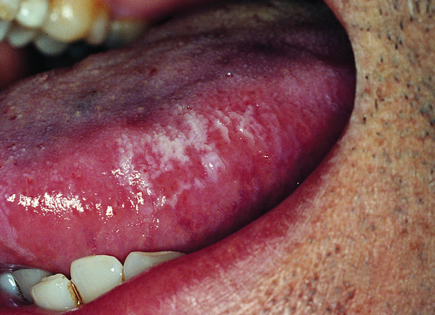
Which of the following is the most likely diagnosis?
A. Candidiasis
B. Leukoplakia
C. Lichen planus
D. Oral hairy leukoplakia
Answer and critique
The correct answer is B: Leukoplakia. This question can be found in MKSAP 15 in the General Internal Medicine section, item 29.
This patient's oral lesion is most likely leukoplakia, a precancerous condition that represents hyperplasia of the squamous epithelium and is particularly common in smokeless tobacco users. Leukoplakia presents as a white patch or plaque with changes in the mucosal surface texture. About 1% to 20% of lesions will progress to cancer over 10 years. However, most lesions resolve within 2 to 6 weeks of cessation of smokeless tobacco use. A related lesion, erythroplakia, is characterized by a red mucosal patch or plaque. Biopsy of the lesion shows severe dysplasia or malignancy in 50% of patients. Patients with either red or white oral lesions that persist for longer than several weeks should be referred for evaluation and biopsy. The patient should be counseled to stop chewing tobacco.
Candidiasis causes white plaques on the buccal mucosa, palate, tongue, or oropharynx. Risk factors include diabetes mellitus, immunosuppression, use of inhaled corticosteroids, or wearing dentures. This patient has none of these risk factors, which makes candidiasis very unlikely. The plaque can easily be scraped off, and if the diagnosis is uncertain, a potassium hydroxide smear can be done on the scrapings, which will show budding yeasts with or without pseudohyphae.
Lichen planus is a disease of unknown cause that occurs on the skin, nails, and mucous membranes in middle-aged adults. Oral lesions may be the only manifestations. It is typically characterized by a network of white, lacy-appearing hypertrophic mucosa on the buccal mucosa, gingiva, and tongue. Additional clinical presentations include papular, atrophic, and painful erosive lesions.
Oral hairy leukoplakia is characterized by white, corrugated, painless plaques that typically develop on the lateral tongue but also occur on the floor of the mouth, palate, and buccal mucosa. Unlike the plaque due to candidiasis, the plaque caused by oral hairy leukoplakia cannot be scraped off. Although it may resemble leukoplakia on physical examination, it is not premalignant. It occurs almost exclusively in patients with HIV infection and for that reason is unlikely in this patient. It is caused by the Epstein-Barr virus and may respond to antiviral therapy.
Key Point
- Leukoplakia is a precancerous lesion that represents hyperplasia of the squamous epithelium and is particularly common in smokeless tobacco users.