MKSAP quiz: Rash on the back of elbows and knees
A 50-year-old woman is evaluated for a rash on the back of her elbows and knees. A similar rash has occurred in the past, with her first episode as a young adult. She has used over-the-counter hydrocortisone cream without relief. She does not smoke or drink and is otherwise healthy.
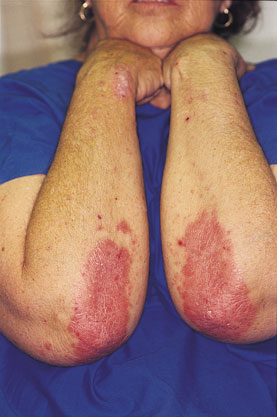
The skin examination of the back of the patient's elbows is shown. The rash covers less than 3% of her total body area. Laboratory studies, including complete blood count and differential, basic serum chemistries, and urinalysis, are normal.
Which of the following is the most appropriate next step in the management of this patient?
A. Topical coal tar
B. High-potency topical corticosteroids
C. Topical tacrolimus
D. Phototherapy
E. Methotrexate
Answer and Critique
The correct answer is B) High-potency topical corticosteroids.
The clinical presentation and physical findings in this case are suggestive of psoriasis. When the plaques of psoriasis are localized and involve less than 5% of the total body area, treatment with a topical agent is appropriate. In this case, high-potency corticosteroids should be used for approximately 2 weeks. Topical corticosteroid therapy can then be rotated with other topical therapies, including topical vitamin D analogs, retinoids, anthralin, or tar preparations. Topical coal tar can be used as a corticosteroid-sparing drug in resistant cases and is very effective when combined with ultraviolet B phototherapy. However, the rate of patient acceptability of coal tar therapy is low because of its unpleasant odor and staining, and some evidence from animal studies suggests an increased risk for skin and uroepithelial cancer associated with this treatment. Topical tacrolimus (a nonsteroidal agent with topical anti-inflammatory activity) is helpful for treatment of psoriasis on the face and intertriginous areas but is of limited benefit on chronic plaques in other areas. Phototherapy is effective in the treatment of plaque or guttate psoriasis; it is generally used when large areas of the body are involved and topical therapy is not practical or in cases in which the patient has been resistant to topical therapy. Methotrexate is an established systemic treatment for psoriasis but is not indicated in this patient with involvement of less than 5% of total body area and who has not yet undergone a trial of high-potency topical corticosteroid therapy. Methotrexate has antiproliferative effects and can cause bone marrow toxicity, stomatitis, gastrointestinal intolerance, fever, and alopecia. Methotrexate is associated with chronic hepatotoxicity and requires monitoring of liver function, although a baseline liver biopsy is no longer indicated in patients who take this drug. Methotrexate is a teratogen and cannot be prescribed to women who are pregnant or considering conception. Other systemic medications that are Food and Drug Administration approved for treating psoriasis are the immunosuppressive agents fumarates or cyclosporine or the new immune response modifier biologic agents, including alefacept, efalizumab, and adalimumab.
Key Point
- When the plaques of psoriasis are localized and involve less than 5% of the total body area, treatment with a topical agent is appropriate.