Put patients in the driver's seat to steer toward better health
Engaging patients in managing their own chronic diseases can be the key to helping them achieve their goals and improve outcomes.
Two decades ago, when she was fresh out of training, Chicago internist Doriane Miller, MD, concluded a visit with a patient newly diagnosed with diabetes by handing the patient a pamphlet and advising them to read it before their next visit. At the time, it was the generally accepted approach to patient education.
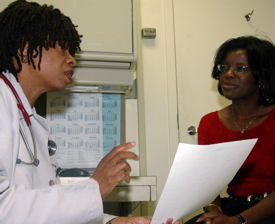
“But what it was, in fact, was a one-way conversation,” said Dr. Miller, who is now National Program Director for New Health Partnerships (NHP), an Institute for Healthcare Improvement initiative, funded by the Robert Wood Johnson Foundation, that focused on actively involving patients in their own care. “The information was very generic, and it also wasn't focused on that patient's particular goals or values.”
Today, most internists would likely agree that the old paradigm in which a doctor reels off instructions to a mostly passive patient falls somewhere toward the bottom of the effectiveness scale. In the dawning of the pay-for-performance era, engaging patients in self-management is widely considered a more effective way to improve health and outcomes.
However, many internists either aren't convinced that the goal-setting strategy works or find that their attempts yield little. Others are understandably concerned that taking even an extra three minutes to address goal-setting collaboratively will throw a wrench into an already overbooked schedule.
Dr. Miller and others involved with NHP are trying to change those attitudes by highlighting the growing body of evidence suggesting that chronic-disease outcomes improve considerably when patients are the primary drivers in managing their diseases. As a bonus, noted Dr. Miller, patients are often more inclined to work with their physicians when they are involved in treatment decisions.
Collaborate and engage
NHP, an outgrowth of the former Quality Allies program (also funded by the Robert Wood Johnson Foundation and with support from the California Health Care Foundation), is following 25 ambulatory care teams throughout the country that are designing and testing self-management support best practices. The teams' progress and findings—and their setbacks and challenges—will be shared through forums on the NHP Web site.
The three-year, $3.75 million initiative's objective is to identify and ultimately spread collaborative self-management practices that prove effective in boosting physician-patient communication about goal setting, information sharing and problem solving. The idea is to manage diseases in a way “that helps patients achieve the goals that they have determined,” said Dr. Miller, who is section head for general internal medicine at Stroger Hospital of Cook County, Ill.
If that sounds like a given, it's anything but, according to Alan Glaseroff, MD, chief medical officer of the Humboldt Del-Norte Integrated Practice Association in Eureka, Calif., a family physician who participated in the Quality Allies program.
“It's really about using motivational interviewing techniques—less of telling patients what to do and more of drawing out of them what they want to do but are ambivalent about,” he says. “I don't think physicians are necessarily trained to work with patients in a collaborative fashion.”
Practical experience
Family practitioner Robert Mead, MD, president of Bellin Medical Group in Green Bay, Wisc., acknowledged the obstacles in collaborative goal-setting, but he also has become a believer in its potential, based on his practice's experience. Since the practice applied the concept with diabetes patients in November 2005—using motivational interviewing techniques to have patients identify goals, and having triage nurses follow up frequently on patients' progress—outcomes have improved significantly. A year into the effort, the percentage of patients with controlled hemoglobin A1c levels jumped from 57% to 75%.
“That was a major change,” Dr. Mead said, adding that he has learned a lot about patient-initiated goal setting in the process. “Some patients come up with unique goals—like ‘I just want my leg to feel better,’ or, ‘I want to be able to go to church.’ These are things you wouldn't think of as a clinician, but they're important for the patient. Patients have to discover for themselves what their goals are and how to achieve them.”
The other potential benefit of letting patients drive the goal-setting and self-management is reduced provider frustration, says Dr. Glaseroff, who has witnessed successes similar to Dr. Mead's in his own small practice.
“When you go home at the end of the day feeling like you've been effective, your morale is much higher,” he said. “Part of the burden, for internists and family physicians when patients don't do what they recommend—is that when you do that for months and years, you start taking on the burdens of the world,” he said. “Burnout is a real possibility. You do less of that when you work collaboratively.”